
EVOLUTION OF HMS FURIOUS
Furious was originally intended as a ‘large light cruiser’ to support a planned Pomeranian invasion. Its main battery was 18in guns in two single turrets. After the plan was cancelled, construction continued.
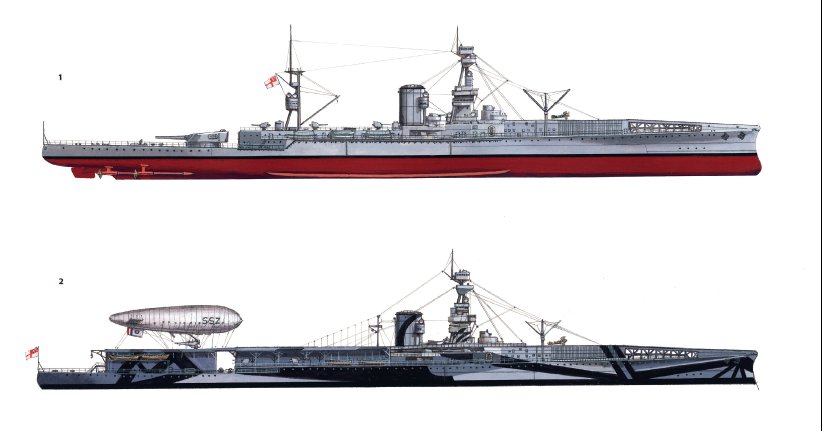
By 1917, shortcomings of Britain’s existing carrier force had become obvious. Merchant conversions were too small and too slow for fleet needs. Furious, nearing completion and of questionable value as a surface warship, was converted to a seaplane carrier. When commissioned in June 1917, Furious appeared as it does in profile 1. The aft 18in gun turret was retained, the forward turret removed, and it was replaced with an aircraft hangar. A large, downward-sloping flying-off deck was added, modelled on that of Campania’s. Furious emerged as a mixed carrier, similar to others then in the Royal Navy. Operational trials during 1917 revealed a need for a landing deck. Firing its 18in gun also damaged the ship’s structure. In November 1917 Furious started a rebuild to change it into an aircraft carrier. The turret was removed and replaced with a landing deck and hangar. Gangways along the ship’s side linked the two flight decks. It returned to the fleet in March 1918, appearing as it does in profile 2.
The third incarnation of Furious as an aircraft carrier was too late for WW1.
HMS Argus & HMS Vindictive
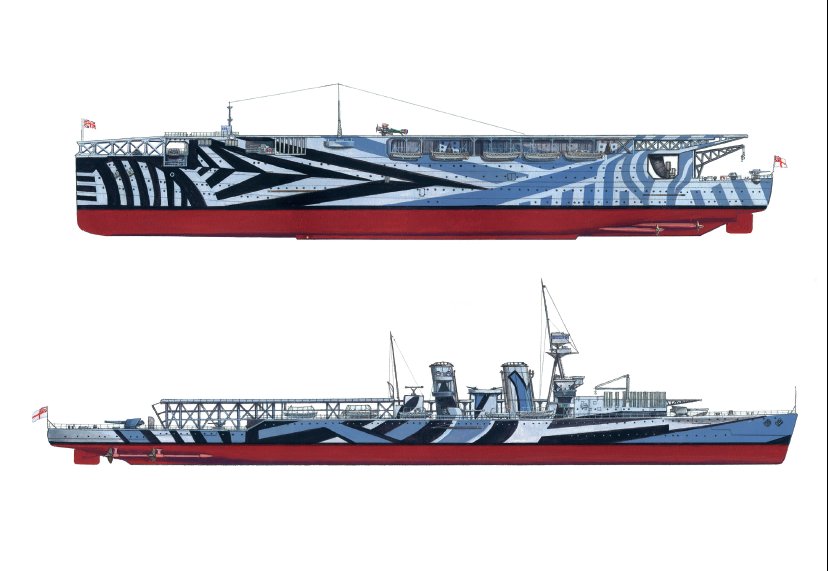
When the Royal Navy needed more aviation ships, the unfinished Argus, intended as a high-speed cargo liner, was a logical conversion candidate. By then the ability to launch and land aircraft on a ship’s deck was desirable. Rather than build Argus as a mixed carrier, a more radical solution was
proposed: put a flat, unobstructed landing deck running the length of the ship. Argus carried the unobstructed deck to the extreme of allowing only a small retractable charthouse above the flight deck, and angling smokestacks and antennae off to the side. Vindictive was built with a flying-off deck forward, and a landing deck aft. As much a demonstration of a mixed-use warship as of an aircraft carrier, Vindictive began as a Hawkins-class
cruiser. It had the speed and (as was believed) size requisite for an aircraft carrier. Unfortunately, retaining cruiser functions crippled its usefulness as an aircraft carrier. To allow the aft turret a free field of fire, the landing deck’s potential length was shortened by one-third. Turbulence from the
superstructure and smokestacks made landing dangerous.

